Lessons From Preparing My Copperplate Exemplar
- Personal
- 0 comments
Around this time last year, I was busy preparing my Copperplate exemplar for submission to the Calligraphy & Lettering Arts Society (CLAS UK) certificate assessment.
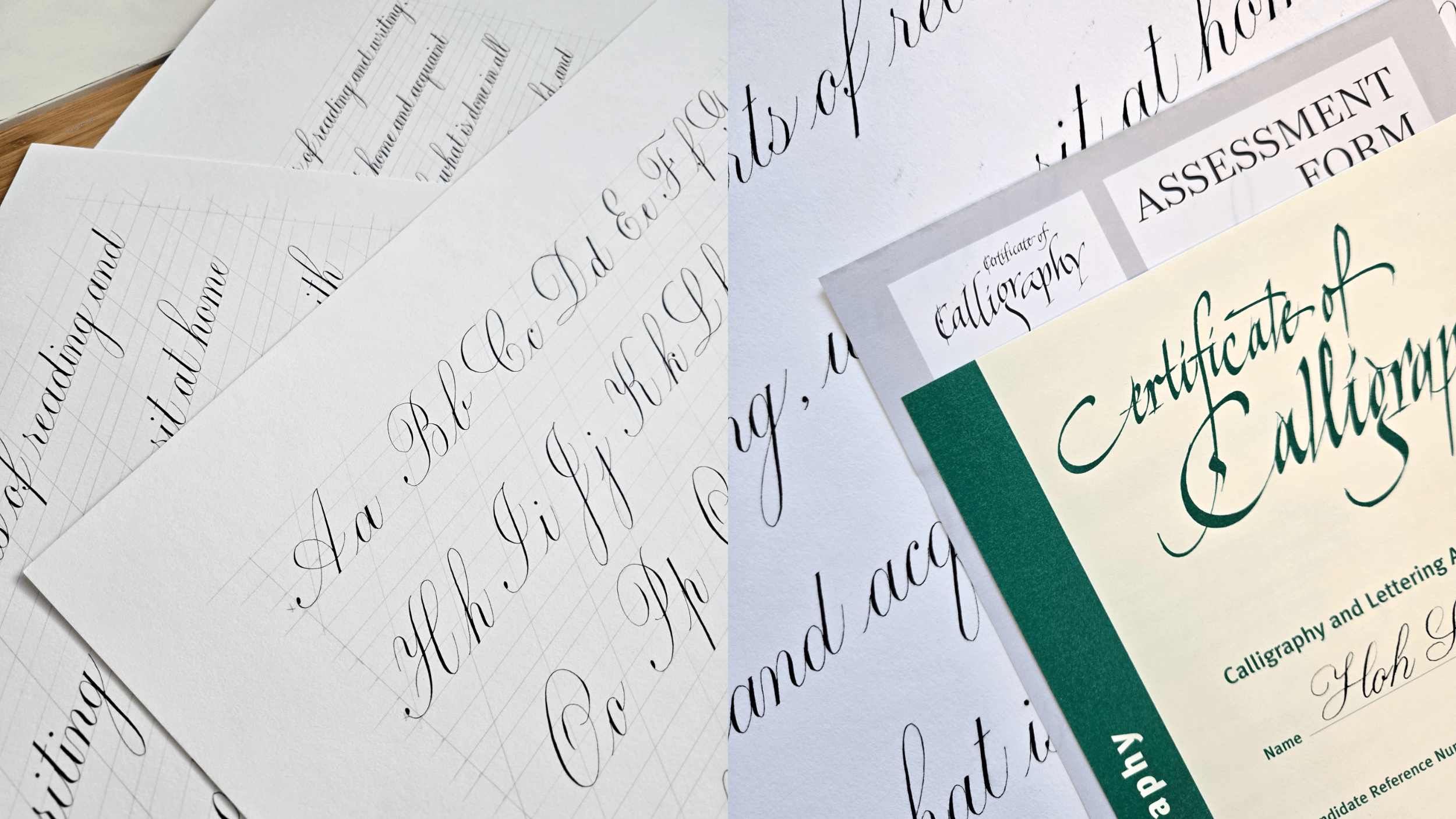
If you’re not familiar, CLAS UK offers a Certificate of Calligraphy where you submit exemplars for assessment. You receive a certificate with your grade, along with detailed feedback based on five criteria.
It really tests your foundational knowledge of the script: letter forms, proportions, ratios, consistency, spacing and more.
If you’re considering submitting your exemplar this year (deadlines are 30 April and 30 November), I thought it might be helpful to share what the process was like for me and what I learnt.
It is incredibly helpful to have another pair of eyes.
I remember feeling both confident and doubtful while preparing. I think my Copperplate’s pretty consistent, but there were still blind spots I didn’t notice. I’ve since incorporated the feedback to improve the consistency of my script.
(That’s why I started my monthly Copperplate Critique exercise. I realised how valuable structured feedback from someone else can be.)
At the same time, the assessment felt deeply personal. It almost felt like a critique of my discipline and ability. I had to detach and remind myself that it was an evaluation of my script, not of me as a person.
It is really hard to produce a “perfect” exemplar.
Each time I made a tiny mistake, I wanted to scrap the entire sheet and start from scratch. If I did, I would have ended up with a whole stack of almost blank papers.
Instead, I pushed through and completed the whole exemplar, sitting with the discomfort of imperfection.
In doing so, I noticed that I made mistakes most frequently in the first few letters. Probably because of hesitation and the hope of a perfect exemplar (please don’t let me waste this sheet of paper).
It also helped me recognise my sweet spot: two lines of intense, focused writing is about all I can manage. Beyond that, I get distracted, my hand gets tired, and my script suffers.
In the end, I wrote three full exemplars and chose the best one. It wasn’t perfect, but it was the most consistent.
The preparation process turned out to be the most valuable.
Preparing for this submission required me to slow down in a way that’s completely different from everyday practice.
I couldn’t rush through practice. I couldn’t “just write something”.
I pulled out my exemplars to study them critically. I examined each stroke, each shade and each letter’s proportion. I spent weeks learning and practising each basic stroke and letter before I began writing the final exemplars.
It felt as though I was relearning each letter from scratch. This process deepened my understanding of Copperplate far more than the certificate itself.
I found the certificate and feedback immensely helpful.
But the most growth happened while preparing for it: both in the consistency of my script and in my emotional resilience.
Even if you’re not submitting your exemplar for a certificate, perhaps you can learn from the spirit of it.
Can you slow down and examine each stroke, each letter again?
What about revisiting the foundations? Will you notice something new?
What would it feel like to prepare your own exemplar as a personal challenge?
This was first published in my email newsletter, 💌 Curious Letters, where I share tips and stories about calligraphy.
To receive emails like this one, sign up in the footer ↓ down below.
→ hey there
I’m Dawn from Singapore.
After leaving a corporate job in the throes of the pandemic, calligraphy has given me more than a hobby and a creative outlet.
Calligraphy challenges me to keep learning, helps me to calm down and focus, and has connected me to so many calligrafriends around the world.
Drop me an email at any time if you have questions / problems while learning calligraphy, or just want to chat about calligraphy! ♥️